The Border with North Korea
One of the main things I’d been wanting to see in Korea was the border with the North. Asking around, it seemed that the best tour was through the USO based out of Camp Kim in Seoul. For 92,000 Won (roughly 96 USD) it looked like the best deal for what you saw as it took you too a number of sites in and around the DMZ.

You can see on the right the barbed wire fence that ran the length of the Han river towards Seoul.
The day started early with having to be at Camp Kim for 7 am. After signing in and an ID check, we were off and up the highway hugging the Han River. It doesn’t take long to get out of Seoul before barbed wire fencing and guard posts began to crop up; Our tour guide explained that they stretch so far down the river as a precaution after an attempt by North Korean soldiers to assassinate the then President Park Chung-Hee (although after doing some digging it turns out they crossed further up the Imijin river, which flows into the Han). Naturally as we got closer, the guard posts seemed to get bigger, I started to notice flood lights on the fences, the layers of barbed wire began to multiply too two, then three layers thick. You begin to see first hand the seriousness the South takes the North.

An hour and a half, and a few military checkpoints later, we arrived at Camp Bonifas, and it was camera’s away. The base is located 400 meters (a quater mile) south of the DMZ, and then another 2 km (1.24 miles) from there to the Military Demarcation Line (MDL), the actual line separating the two countries. Up until 2006, Camp Bonifas was home of the the United Nations Command Security Battalion tasked with enforcing the 1953 Armistice between the two Koreas, where since it has been run by the Republic Of Korea. Despite being a ROK installation, we still went through another ID check by US Military Police before we were let onto the base.
Sign Here
Stepping off the bus and into a visitor’s center, you’re given a “if North Korea invades and you die, it’s not our fault” waiver to sign, followed by a power point primer run by the US MP’s. They went over the history of the Korean war, the DMZ, and how the 4 km wide no-go zone came to be as well as some of the altercations that have gone on since the Armistice agreement. Namely the Axe Murder inicident in August of ’76, and the firefight in 1984 that ensued after a Soviet Journalist on the North Korean side sprinted across the border to the South Korean side, that left 3 North Koreans soldiers and one South Korean soldier dead. I guess that’s why they have you sign the waiver first…
Coming out of the visitor center, we changed buses onto ones outfitted in UN insignia and headed off. After crossing through another checkpoint shouldered by rows of more barbed wire, we were officially in the DMZ but were reminded again no photographs. The US MP begins telling us about how unique the vegetation and animals have become in this region due to it being isolated for so long. Apparently every two years National Geographic comes up and discovers completely new vegetation in the region. He joked how pristine the area can feel until a pig unknowingly trips one of the landmines.
This Little Piggy Went Everywhere.
The curving and flowing road almost reminded me of the back country roads up north in cottage country back home. Maybe it was the overcast and fog, but you really felt isolated; it was quiet, scenic, and ironically, peaceful almost if you could manage to forget about the minefields for long enough.
The Conference Rooms

The Blue Conference Rooms
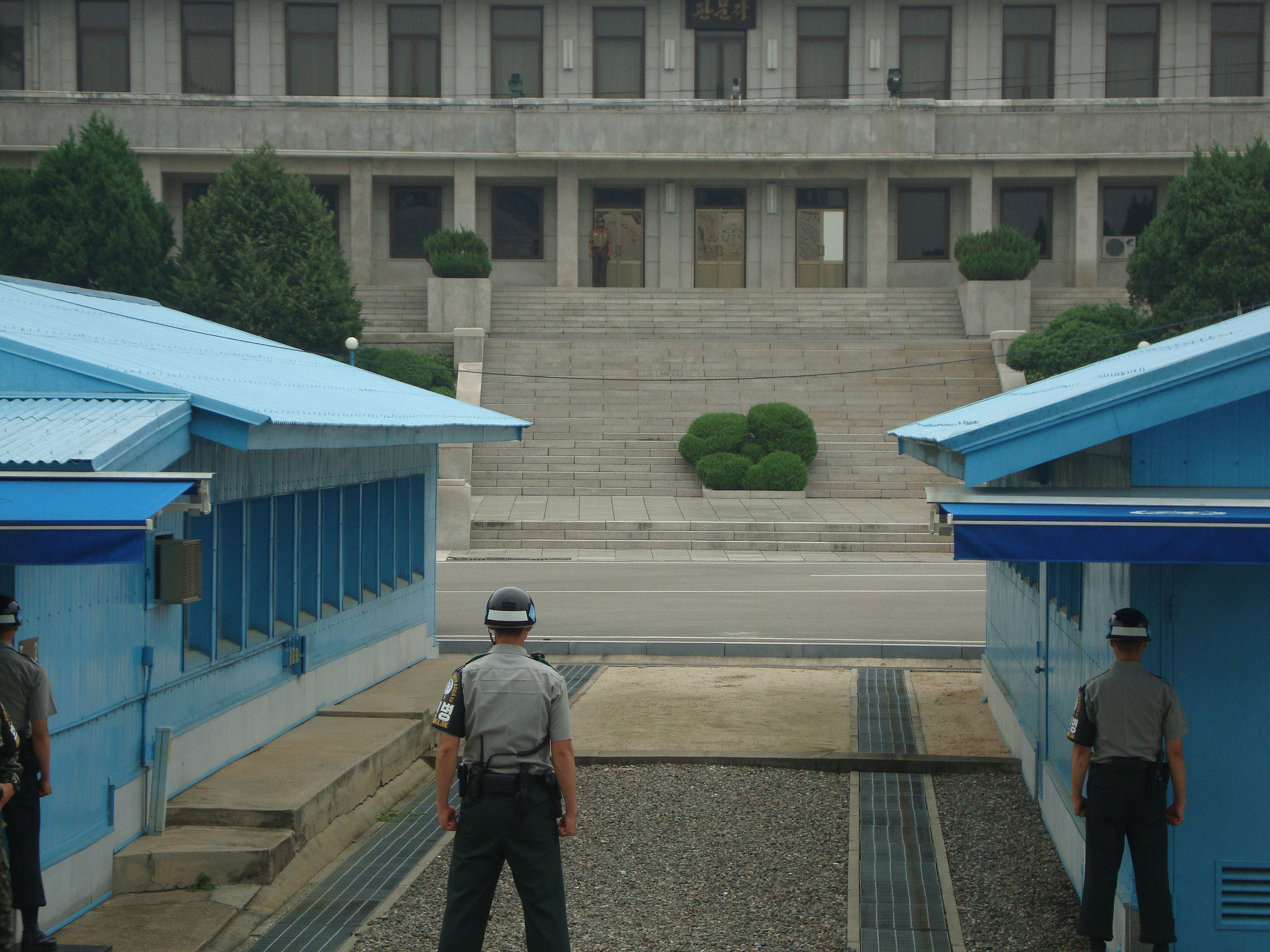
Two kilometers later we pulled up to our first stop, the Conference Rooms. We were told only to take pictures looking forward towards the North; No photo’s of the ROK and UN buildings except for the blue rooms in front.

At the risk of sounding touristy, unfortunately there was only one North Korean guard out, and we were told that the South Korean guards only really go into formation like in the pictures above when tour’s come through.

After a few questions with the US soldier, we headed into the Blue Conference rooms. Where you can “Technically” step into North Korea.

This is the conference rooms which straddle the border, so although you can technically stand in the North, we were told not to go behind the soldier at the back of the room there, otherwise he would “do everything in his power in preventing you from making it any further to get that passport stamped.”

Left leg is enjoying democracy in South, Right leg is a little Red being in North.

South Korea…

…North Korea (well…technically).

“And Here I am, stuck in the middle with you”
We were told that the soldiers stationed up here were the top of the crop from the ROK military, as you’d expect, but were also all black belts in Taekwondo. I didn’t need to know that to understand that if I stepped out of line, this guy would drop me and not break a sweat.
The Bridge of No Return

The Bridge of No Return
As quick as we arrived, we were gone and off to the next area. We pulled up to a lookout post not to far away where you could overlook North Korea, their fake Propaganda Village (complete with painted on windows, and single lightbulb buildings), the Bridge of No Return, as well as their massive flag that they got into a pissing contest with the South over whose was bigger.

We were able to drive up to the bridge, but unfortunately weren’t allowed to get off the bus.
At the end of the Korean war, both sides exchanged POW’s over the bridge where each person was given a choice between the south or the north, but once they chose, they could not return, hence the name, Bridge of No Return.

North Korea’s Propaganda village
Loud speakers would play propaganda up to 18 hours a day. The village itself is made up of empty buildings; We were told even that at night you could see the light through the windows dimming from the top floors down to the bottom floors, meaning the buildings were likely just shells with one light at the top of the building, and no floors to block the light. We returned to the Visitor’s center where before switching back to our original bus, we were given a couple minutes to check out a museum.


A sign from the MDL line indicating the actual line separating the two Koreas.

Two North Korean Caps from the Soviet Defector Incident in 1984

A podium with a plaque for each country which aided in the UN side during the Korean war.

Canada provided over 25,000 troops during the Korean war.

They had a copy of the Armistice agreement with some recognizable names on here.
God Damnit Reddit
As we were waiting to get ready for our next stop I decided to waste sometime on my phone. I pull up Reddit and start scanning through it for anything that can take my attention for 5 minutes. And then notice this:

Perfect Timing. Thanks Reddit…
Dorasan Station
From the DMZ, we headed out of Camp Bonisfas and off to our next stop at Dorasan Station, a train station which has been set up in hopes that if/when Korean unification actually does happen, this will be one of the main hubs of transportation between the two. With all of this, it’s clear that South Korea is wanting to head in the direction of reunification.

Even here, where civilians where allowed to walk around it seemed, they were still restricting of where I could take photos.

You don’t see that too often.

All aboard…?

Actually one of the nicer looking train stations I’ve seen before.

Next stop … oppressive dictatorship.

This was the DMZ train that apparently runs from Seoul up to here.

There were ROK guards throughout the entire station.

“Not the last station from the South, but the first station toward the North.”

They’re end goal is to link South Korea to the Trans Siberian/Manchurian/Mongolian lines which connect continental Europe to East Asia. This would allow South Koreans to be able to reach London by train. For all intensive purposes, I’m on an island right now.
The Observation Post

The observation post allows you to overlook an even larger portion of the bordering region with the North. It allows you to see the Propaganda Village, the Conference Rooms, Dorasan Station, to where it leads, and a GPS jamming tower; ….. Or so I’m told, since the fog had actually thickened which didn’t allow for much view past the border. Also, GPS jammer???? My phone’s GPS had no problem getting a good lock on my position through out the day….

The “view” of North Korea

The entrance into the DMZ

Dorasan Station

The Third Tunnel

Over the years, a number of tunnels were discovered coming from North Korea into the South. A claim the North tried to write off as “coal mines”. The portion of the tunnel which you’re allowed to visit is a steep decent down a long tunnel taking you 240 feet below ground. A light fog actually begins to form at portions of the descent due to the temperature drop. After the walk down, it is a 500 foot walk through 2 m by 2m tunnel through solid granite originally dug out by the North. Unfortunately this was another picture ban area, and being a 6’5″ guy I didn’t want to stand around too much, I wanted in and out. That said though there are a number of pictures online, 2 of which are below:
http://www.seoulcitytour.net/English/img/dmz54.jpg
The tunnel you take down to get to the North Korean tunnel.
http://blogs.bootsnall.com/llew/files/2011/12/IMGP7412.jpg
They dug this out of solid granite.
After coming out of the tunnel we had a few minutes to catch our breath (after walking the 240 feet back up) and walk around the grounds.

A sculpture showing the two Korea’s reunified.

A sign warning for mines.

And how close those signs were.

Showing the 38th parallel

Everywhere you went, there were fences with mine warnings on them.
Heading Back
We all hop back on the bus, sweaty from the climb back up and the humidity that comes with Korea at the tail end of the wet season. Coming back, we pass the same barbed wire.

Heading back down the river.

The barren land almost feels like the coast in Whales or Ireland…

Then the barbed wire begins to thin out a little.

We begin to approach Seoul…

And it’s not too long before the barbed wire disappears and you come up on a … water park?
Final Thoughts on it All

You could get North Korean Soju, Candies, as well as some North Korean currency apparently, although I couldn’t find any. The amount of souvenir shops at each stop felt odd and a little out of place.
The visit to the DMZ was odd in a sense. Between the military checkpoints, road blocks and barbed wire fencing, at times it felt like you were seeing first hand the on going tensions; while at others times it felt very touristy, almost as if you were at Disney World with land mines; with all the families, selfies and branded souvenirs that come along with it. It was as if I wasn’t sure whether I was on a safari, or at the zoo in a sense.
My final thought on it before we arrived back at the base was of whether the divide here would always be like this; or for how long it’ll continue like this at least. After university in the 70’s, my Father went backpacking through Europe, but didn’t go to Berlin due to the Wall and all the Cold War fun going on. Yet, 30+ years later almost to the day I took a similar trip to him but made a point of seeing Berlin. I was able to walk across where the wall used to stand, I could walk up to what was left of it. I remember thinking how odd it was that I could walk across this line that used to cut a city, families, and an entire culture in two, yet my dad couldn’t have at my age. What happens with Korea, time will tell, and maybe my kids 30 some odd years from now will walk across the what used to be the South/North border freely and think the same thing I did in Berlin back in 2010.
Only time will tell.