Hidden Temples and a History Lesson
I had read there was a beautiful temple on the south west side of the island on/in Mount Sangbangsan, although the more research I did, the less I found about it. From where I was in Seogwipo, it was a bus ride to the main terminal in town (which as it turns out, there’s two halves of Seogwipo, one where I was by the harbor, and the other where the bus terminal and World Cup Stadium are). After switching over buses, grabbing some kimbap triangles and snickers bars (breakfast of champions), we were off.
After the ride down the southern coast of the island, the stop came up; If you come here, note that it’s going to be significantly cooler and windier than Seogwipo, I realized this the instant off the bus getting blasted by the wind coming off the sea.


Walking around, there’s a number of statues and pagoda’s as well as a large golden Buddha up a hand full of steps.


The temple area was nice, but felt rather small. I was confused as to why people were recommending it, it seemed that for the exception of the golden Buddha, there wasn’t much else to see that made it unique from any other temple. With that thought in mind though, I knew there were other statues I’d seen pictures of, but hadn’t come across. Coming across a few unadvertised paths that led off in to different directions, I decided to explore a bit.
One path led not to far to a rather under-kept Korean home with a gold statue in the middle. It was odd, as it didn’t look like there was much to it beyond this big statue…glory days gone past, or maybe in the middle of “under new management”.
Doubling back, I found a path between the main temple building and the elevated area containing the golden Buddha. The path was a small set of stairs snaking up into the woods and up the side of the domed volcanao. Considering I was carrying all of my gear for my trip, I took my time hiking up.


The route is paved with blocks the entire way up, and provides an easy climb and a broad view of the entire bay area below. Half way up, you come up on a rest station with a rack of hard hats at the far end with a sign giving a strong recommendation to wear one.
Past the rest station it quickly becomes apparent as to why there’s helmets, as the path now becomes covered by some pretty heavy gauged steel wire looped to together to form a barrier net above the path way to catch any falling debris. I was wondering how really likely any falling rocks were. Looking up while pondering, I could feel a noticeable amount of rock particulate fall into my eyes. Brushing it out quickly, I could see why they add the heavy duty steel netting.


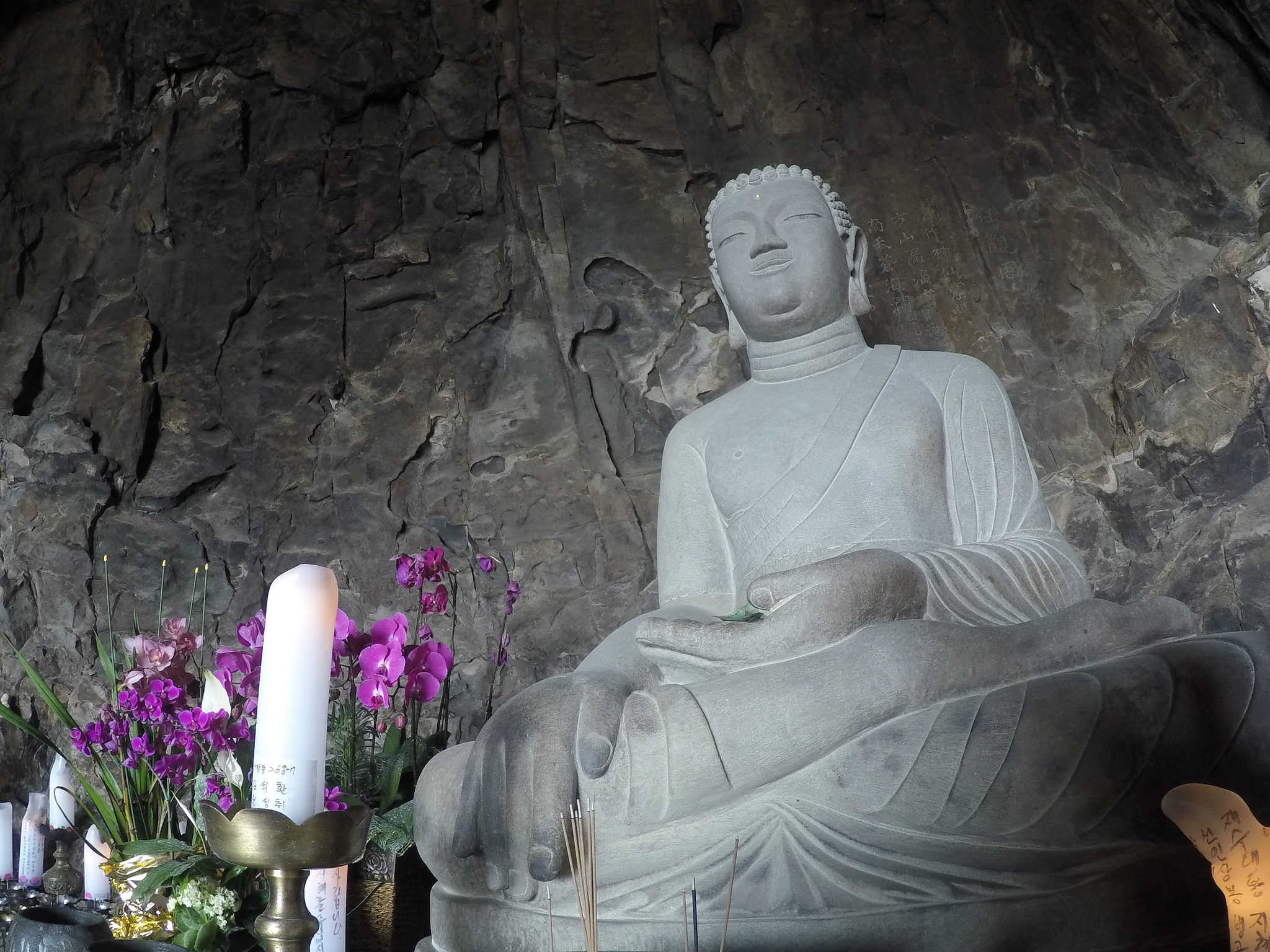
I started to hear chanting and Buddhist drumming, and then quickly came up on a Buddhist statue up a flight of stairs recessed into a cave. In-front was a small pool of deep blue water catching heavy drips falling from the top of the cave. It doesn’t take an engineering degree to realize this thing wasn’t the most structurally sound cave. Walking in, I looked to my left and noticing an elderly Korean lady sitting, looking over the cave as person after person walked up the flight of stairs up to the statue. It wasn’t long before I was the only one there. With the water dripping, the sound of the sea behind and below, and birds chirping on the cliff edges; It all felt incredibly peaceful and real, if not for the small set of ipod speakers behind the elderly lady playing the chanting and drumming that I’d heard earlier. But hey, this is the 21st century, can’t complain.


After truly soaking in the whole environment in the cave, I decided I’d hike back down and catch the next bus. As I got to the bottom I saw the bus pull up, it only coming once an hour, I lept down the steps running for it. As I ran across the back end of the bus and ran for the door I noticed this HUGE European tall ship beached on the shore.
I stopped in my tracks dumb founded as to why there was a European Style tall ship on an island in Korea. Looking over at the bus as the last person in line climbed aboard, I figured I was on my own timeline, what the hell, why not.
Shipwrecked
It turned out, back in the 17th century, the Netherlands, being a world power at the time with colonies through out south east Asia, lost a Dutch trading ship when it was caught in a storm and ship wrecked off the coast of Jeju Island.
The survivors were washed up on the shore right where I was standing. They lived in Korea, albeit rather unwillingly, for over a decade before finally escaping with what men were left. They fled to Japan and then eventually made it back to the Netherlands. The story written by the captain was the first printed account of Korea in the west. Pretty damn cool. The ship turned out to be a replica acting as a museum to the whole situation.


After spending an hour in there, I walked out of the museum, ready again to head out. Walking by, I noticed another line of people lining up along a rock face facing the coast. As it turned out, there is a path that loops around a rocky peninsula with amazing formations carved out by the water. Looking at my watch I thought “okay, last one”.


I was around in less than a half hour. It felt as if I was out in New Foundland back home. After seeing that, I’ve decided I have to head out east one I do finally return home.
At this point, I did the math as to what time it was, and knowing the bus out east is a milk run that stops every 10 minutes, that I had to get my ass in gear if I wanted to make it to the far east side of the Island by Udo island.

I hiked back up the ridge to the road, sat on the side of the road, huddled in the cold wind, waiting for the bus, trying to remind my self of where I came from and who I was.
“Cold to a Canadian, is like queing for a Brit, this comes naturally, I can do this…”
The 2 bus, 3 hour ride to the other end of the island gave me time to think finally. I had small plans for this side of the island. I figured it’d be a quick trip out to the temple,assuming a hardly memorable day trip to fill a gap between the things I came for. But it turned out to be a lot fun that resulted in me coming across a handful of things I’d never even knew or heard about, despite all my research.

Finally strolling up to my guesthouse at the end of the day, the sun long gone by this point, I threw my bag down, and felt fully content with this trip. This Island, despite being here in the off season, in the tail end of December, could still impress and give a solid sense of fulfillment in what it has to offer. And I wasn’t even done yet.